6 min read
Give Employees a Practical Path to Using AI Well
 Bill Monreal : October 22, 2026
Help employees use AI confidently with approved workflows, clear data boundaries, hands-on practice, and human review tied to business outcomes.
Our team spent November 4 to 6, 2026, in Orlando, Florida, at IT Nation Connect Global, a conference for IT solution providers. Speakers shared AI best practices, vendors showed off their newest AI products, and ConnectWise leadership talked with service providers about where the industry is heading. That much new technology in one place raises a simple question for any business investing in AI: if the tools keep changing, what do you actually own?
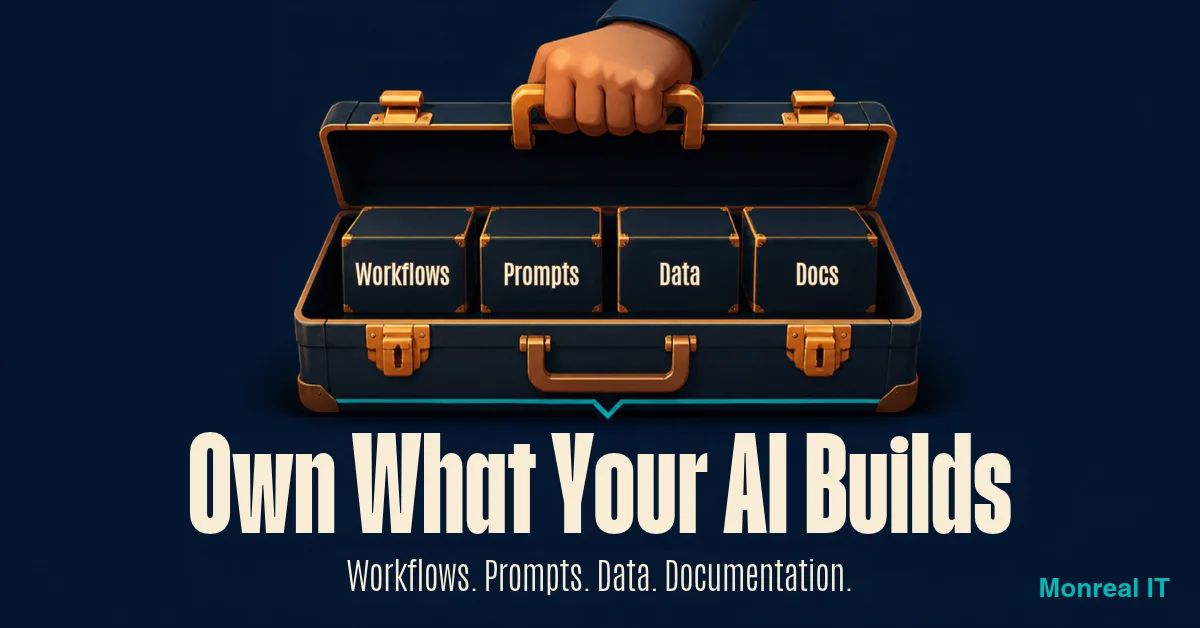
The answer should be most of it. Your business should keep control of the workflows, the prompts and instructions, the connections to your systems, the data behind them, and the documentation that explains how it all works. You should be able to export it, understand it, and hand it to another team or provider without starting over.
At Monreal IT, we build AI work on two principles: security and portability. Security protects you while you build. Portability means you own what gets built. If your needs change, a better tool comes along, or you decide to work with a different provider, your AI investment shouldn't be trapped in someone else's environment.
For an owner, CFO, or COO, this isn't a technical preference. An AI workflow that handles invoice entry or drafts customer email responses becomes part of how the business runs. If only one vendor can see how it works, change it, or move it, you've added a dependency you didn't budget for. Leaving gets expensive, and staying gets harder to evaluate honestly.
AI is a capability, not a tool. A tool is bought. A capability is built, governed, measured, and improved, and you can only keep improving something you actually control.
Ownership means more than having a login. Before a project starts, agree in writing on who holds each of these.
The business logic. This covers the steps of the workflow, the decision rules, the approval points where a person reviews the result, and the exceptions that route to a human. It's usually the most valuable part, because it captures how your business actually works.
Prompts, instructions, and configuration. These shape how an assistant or agent responds, along with its settings, thresholds, and the approved sources it draws from. If they live only in a provider's private workspace, you can't reproduce the results anywhere else.
Your data and the connections to it. Know where your data is stored, which systems the solution connects to, and which accounts and permissions those connections use. Connections should run under accounts your organization controls, not personal or provider-owned credentials.
Documentation and records. You need a plain description of what the solution does, its business purpose, its one primary KPI, who owns it inside your company, and how it has changed over time.
Exportable copies. Where the platform supports it, keep packaged versions of what was built. In Microsoft's Power Platform, for example, Microsoft recommends exporting your customizations periodically so you have a backup in case anything happens.
Lock-in rarely shows up in the proposal. It tends to appear later, in the details.
A solution gets built in a provider's own tenant or subscription instead of yours. Automations run under one consultant's personal account, so they stop when that person leaves. Prompts and logic are treated as the provider's intellectual property. Integrations depend on a proprietary middle layer that only one vendor supports. Or nothing was written down, and the only documentation is the memory of the person who built it.
None of these is automatically a problem. A proprietary component can be the right choice for a specific job. The question is whether you made that choice knowingly, with a plan for what happens if you need to change course.
That kind of planning lines up with established guidance. The NIST AI Risk Management Framework calls for policies that address AI risks arising from third-party software and data, along with contingency processes for failures or incidents in third-party data or AI systems deemed high-risk. A documented exit path is one practical form of that contingency.
For most organizations we work with, we build primarily inside Microsoft 365 and Azure because that environment supports both principles. It offers native enterprise-grade security controls, clear tenant boundaries, and auditability across agents, automation, machine learning, and business intelligence. It's also familiar ground, since most of our clients already work there every day.
When the solution lives in your tenant, under your administrative control, your data stays inside your boundary and the work stays with you. Vendors are enablers, not the story. We develop with platforms such as Microsoft Copilot, Claude, and ChatGPT where they fit the job, but the business logic, governance, and records belong to you.
Portability and security reinforce each other. There is no AI without security, and there is no security without AI. A solution you can see, document, and audit is easier to protect. One you can't inspect is harder to secure and harder to leave.
Whether you're vetting an IT managed services provider Cleveland peers recommend or reviewing the partner you already have, put these questions on the table before work begins.
Whose tenant or subscription will this be built in? Which accounts will the automations run under? Who owns the prompts, workflows, and configuration when the project is done? What documentation will we receive, and who keeps it current? If we end the relationship, what do we take with us, and what would a realistic handoff look like?
A good partner should welcome these questions, and they belong in any managed services relationship, not just AI work. Clear answers up front cost far less than untangling a dependency later. They also fit naturally alongside the rest of your governance, which should be settled before anything is deployed, never retrofitted afterward.
New AI products will keep arriving, and some will be worth a look. If nothing changes in how you build, every new option raises the same uncomfortable question about what you'd lose by switching. When your workflows, data, and documentation belong to you, evaluating something new becomes a business decision instead of a migration project. You can adopt what helps and keep what already works.
We make AI practical and manageable: secure by design, portable by principle, and proven by one number. If you'd like to see whether working together makes sense for your business, Start Here with our Compatibility Check at monrealit.com/compatibility-check.
6 min read
Bill Monreal : October 22, 2026Help employees use AI confidently with approved workflows, clear data boundaries, hands-on practice, and human review tied to business outcomes.
6 min read
Bill Monreal : October 8, 2026Keep deployed AI focused on business results with ongoing performance reviews, security checks, human oversight, and a clear plan for changes.
6 min read
Bill Monreal : October 1, 2026Clarify who owns your cloud systems, approves changes, and reviews performance so business decisions don't fall between your team and IT.