6 min read
Give Every Cloud System a Clear Owner
 Bill Monreal : October 1, 2026
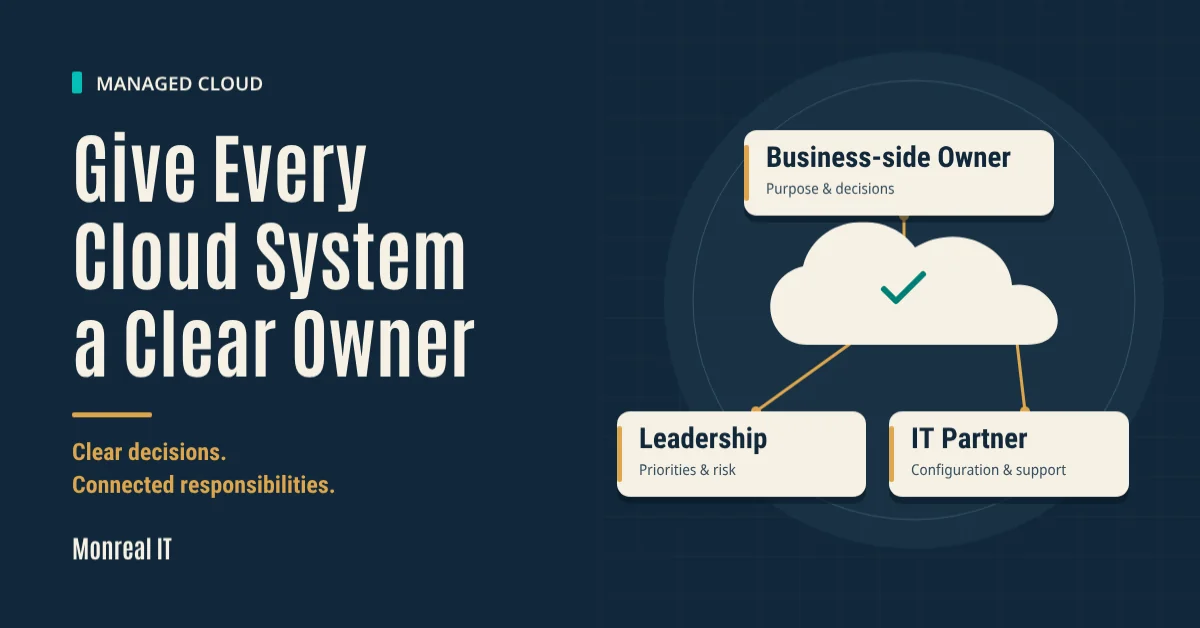
Clarify who owns your cloud systems, approves changes, and reviews performance so business decisions don't fall between your team and IT.


Buying more AI licenses can feel like progress. The invoice arrives, the admin portal fills up, and everyone can say the company is moving on AI.
But access is not the same thing as adoption. Adoption is not the same thing as business value. And business value is hard to prove if nobody agreed on what should improve before the rollout began.
Before you buy the next block of AI licenses, pick one KPI. Not twelve. Not a vague hope that employees will be more productive. One measure, agreed in advance, that tells leadership whether the initiative helped the business enough to continue, adjust, or stop.
That discipline matters because AI is a capability, not a tool. A tool can be purchased. A capability has to be governed, measured, supported, secured, and improved. If the only decision is "who gets a license," the business is starting in the middle of the story.
License adoption is an activity metric. It can tell you how many people have access, how many accounts are enabled, or how many prompts were submitted. That information may be useful for administration, but it does not answer the executive question: did the work get better?
A department might use AI every day and still produce inconsistent results. Another team might use it less often but save hours on a painful recurring process. A third team might discover that the data behind the workflow is not ready. All three outcomes matter, but none of them can be understood from license count alone.
For compliance-driven organizations, this is where enthusiasm needs a little structure. The right question is not "How many people can we give AI to?" The better question is "Which business outcome are we trying to improve, and how will we know?"
That outcome-first lens should sound familiar. It is also how a strong managed services relationship should work. If you're comparing managed IT services Cleveland businesses can actually build around, look for a partner who asks about the business measure before recommending more licenses, more automation, or another platform.
A useful KPI starts with a real business constraint. Where is work slow, inconsistent, expensive, risky, or hard to manage?
Maybe customer service spends too much time drafting similar replies. Maybe the finance team manually prepares the same weekly summary. Maybe managers can't get a clear view of backlog, exceptions, or response times. Maybe employees are already using AI in disconnected ways, and leadership needs safer boundaries before expanding access.
Each of those situations points to a different KPI. Time saved may be right for a document-processing workflow. Response consistency may be right for customer service. Backlog reduction may be right for operations. Reduced risky AI use may be right for governance. Better decision speed may be right for reporting.
This is also where the human in the loop belongs. The KPI should measure the work AI assists, not pretend people disappear from the process. In Monreal IT's view, AI should remove repetitive, mundane, and low-value tasks so people can spend more time on judgment, creativity, and collaboration.
The best first KPI is specific enough to measure and simple enough for the team to remember.
For example:
Those measures are not flashy. That's the point. They connect AI to a business activity someone already owns.
The KPI also needs a baseline. If you don't know the current time, error rate, backlog, or adoption pattern, the first step is measurement, not deployment. A baseline doesn't have to be perfect, but it does have to be honest enough to compare before and after.
NIST's AI Risk Management Framework organizes AI risk work around four functions: govern, map, measure, and manage. That sequence is a useful reminder for business leaders. Measurement is not just a finance exercise. It's part of responsible AI management.
Before expanding AI access, define who owns the workflow, what data the tool can use, what outputs require review, and what the system must never do. Document the intended use. Decide how employees should report bad results, sensitive-data concerns, or unexpected behavior.
This doesn't have to become a 90-page policy project. Simple means practical and manageable. For a first rollout, governance may be a one-page use-case brief, a short employee policy, a permissions review, and a named owner who checks the KPI.
Microsoft also makes an important distinction around workplace AI protections. Its documentation for Microsoft 365 Copilot and Copilot Chat describes enterprise data protection for prompts and responses under Microsoft commercial commitments. That kind of protection is useful, but it doesn't remove the need to configure access, train employees, choose safe use cases, and monitor outcomes.
There is no AI without security, and there is no security without AI. That's why cybersecurity belongs in every AI decision. The more AI touches business data, the more important it becomes to know where that data lives, who can reach it, and what the workflow is allowed to do.
A KPI only helps if leadership agrees what it means.
Before the rollout, decide what result would count as a pass, a partial pass, or a stop. If the goal is time saved, how much time is enough to justify the cost and support effort? If the goal is consistency, who reviews quality? If the goal is reduced risk, what behavior should change?
This keeps the pilot honest. Without a stopping rule, AI experiments can become permanent expenses because nobody wants to admit the first version didn't work. A clear pass or fail protects the business and the team. It gives everyone permission to scale what works, improve what's close, and stop what's not worth carrying forward.
The decision should include cost, too. License fees are only one part of the investment. Training, governance, process design, data cleanup, integration, user support, and ongoing management all matter. AI can absolutely produce value, but the math should include the work required to make that value real.
One useful KPI also helps build the next project.
When a rollout produces a measurable result, the business learns which workflows are good candidates, which data sources are ready, which employees need support, and which controls should be reused. That becomes the beginning of an internal AI factory: a prioritized pipeline of use cases with the highest productivity yield and the lowest risk.
The opposite approach is a pile of disconnected experiments. One team tries a meeting assistant. Another builds a prompt library. Someone else automates a report no one reads. Each idea may have merit, but without a shared method, leadership can't compare value or risk across the organization.
The Monreal Way favors a calmer path: assess and advise, implement and test, then support and continuously improve. For Managed AI, that means an AI Game Plan Assessment, practical prioritization, governance before deployment, a limited pilot with one KPI, and ongoing management after go-live.
Before buying the next AI license bundle, ask five questions:
If those answers are unclear, pause the purchase. That doesn't mean the organization is anti-AI. It means leadership is treating AI like a business capability instead of a shopping cart.
More licenses may be the right decision. More access may help employees. More automation may return meaningful time to the business. But the next step should be tied to one number leadership cares about.
Pick the KPI first. Then buy, pilot, and improve with a practical pass or fail in mind.
6 min read
Bill Monreal : October 1, 2026Clarify who owns your cloud systems, approves changes, and reviews performance so business decisions don't fall between your team and IT.

6 min read
Bill Monreal : September 24, 2026Give internal AI better source material. Start with approved documents, clear owners, current information, and access that matches people's work.

6 min read
Bill Monreal : September 10, 2026Klarna, Ford, and IBM show why AI creates more value when automation handles repetitive work and people retain judgment.