6 min read
Keep AI Useful After the Pilot Ends
 Bill Monreal : October 8, 2026
Keep deployed AI focused on business results with ongoing performance reviews, security checks, human oversight, and a clear plan for changes.


If your employees have AI access but still aren't sure what they're allowed to do with it, start by making one useful workflow clear. Define the task, approve the data and environment, teach people how to check the result, and give them someone to ask when they're unsure. Set governance and data readiness before deployment, then practice inside those boundaries.
For an owner, CFO, or COO, the outcome is more consistent work with less avoidable effort. Employees shouldn't have to invent the rules while trying to meet a deadline. They need a practical way to use AI that supports their responsibilities and keeps human judgment in the process.
Begin with the work people already understand. Ask a small team which repetitive task slows them down, what a good result looks like, and where mistakes create rework. Choose a task with a clear owner and manageable risk. Then explain exactly where AI will help and what remains the employee's responsibility.
That conversation needs a business sponsor. A manager should explain why the workflow matters, make time for practice, and resolve competing expectations. Telling people to experiment while measuring them only on their existing workload sends a mixed message.
Be clear about the purpose, too. The goal is to remove repetitive effort so people can spend more time on judgment, relationships, and useful decisions. AI is a capability, not a tool. Buying access doesn't build that capability by itself.
A policy needs to translate into an ordinary workday. Employees should know which account and environment to use, which information is approved for that task, which actions require review, and where to report a concern. Keep those instructions beside the workflow, where people can find them.
Approval needs to be specific. Permission to use an AI application isn't blanket permission to upload client records, financial information, or manufacturing documents. Have the appropriate security, data, and business owners establish the boundaries for the proposed use. For regulated organizations, contractual and compliance obligations belong in that review before deployment.
This is part of cybersecurity as business-risk management. NIST's AI Risk Management Framework calls for AI risk training aligned with people's responsibilities and for defined human oversight roles. It supports making those responsibilities explicit; it doesn't certify a particular workflow as safe or compliant.
Reliable source information matters just as much. Before employees use an assistant to answer questions about company procedures, make company knowledge reliable enough to support the task. A training session can't resolve conflicting procedures or decide who should have access to them.
A demonstration should show the full job, from approved input to reviewed output and the next handoff. A polished response on a screen isn't the same as a completed business process.
Consider an illustrative training exercise for an accounting firm's administrative team. Using fictional information in an approved environment, an employee asks an assistant to draft a reminder about missing onboarding documents. The exercise supplies an approved checklist and a defined tone. The employee checks the draft against that checklist, removes unsupported requests, and approves the message before sending it through the normal process.
Then introduce a deliberate problem: the draft requests a document that isn't on the checklist. Ask the employee to find it, explain why it shouldn't be requested, and correct the message. This is practice in judgment, not just prompt writing. It's an illustrative exercise, not a Monreal IT client result.
Teach the stopping point as carefully as the starting point. If the source is missing, the answer conflicts with a procedure, or the employee can't verify a material detail, they should pause and ask the designated owner. Human review needs authority to reject an output.
AI also extends beyond generated text. A later improvement might automate an approved routing or reminder step. That requires its own design, permissions, and testing.
Choose a trusted colleague who understands the team's work to share approved examples and gather questions. Give that person time and a clear escalation route. Their role is to help colleagues practice and surface friction.
Microsoft's AI Champion guidance draws a useful boundary: champions complement IT, compliance, and training teams. They don't replace those functions or take over security approvals. Keep a similar distinction in your own rollout, even if your organization only needs one peer champion.
Invite employees to report confusing instructions, poor outputs, and tasks that take longer with AI. Treat that feedback as information about the workflow. If people worry that asking a basic question makes them look unprepared, leadership loses visibility into where help is needed.
Agree on one primary KPI before the limited pilot. For the reminder exercise, that might be staff time per approved reminder, including checking and correction. Establish the baseline and the practical pass/fail before testing. Pick one measure of success rather than counting prompts as proof of value.
Quality, privacy, and approval requirements still apply. Faster work doesn't justify skipping them. Compare the measured benefit with training, licensing, integration, and ongoing management costs when reviewing ROI. No improvement or payback period should be assumed.
Keep short practice sessions and an accessible set of approved examples available as the workflow changes. New employees need the same guidance. Existing employees need updates when inputs, responsibilities, or system behavior change. Ongoing management after the pilot should include what employees are finding difficult, alongside performance and security review.
Employee AI adoption depends on managed IT operations, access controls, cloud configuration, reliable data, and clear business ownership. Those responsibilities need to work together. A team can't train its way around an unresolved access problem or an unclear approval process.
If "managed IT services Cleveland" is on your search list, ask prospective partners how they'll connect those responsibilities to your business outcome. Ask who owns the workflow, who handles technical issues, and how employee feedback reaches the people who can act on it.
Monreal IT's Managed AI practice starts with an AI Game Plan Assessment, then prioritizes use cases for productivity, risk, and ROI. Governance comes before deployment, followed by a limited pilot with one KPI and ongoing management. Security and portability guide the work, so clients retain control of what gets built.
Without a clear path, employees keep guessing or avoid using AI. With one approved workflow, useful practice, and accountable support, they have a practical way to build confidence. Start Here with a Compatibility Check to explore whether Monreal IT is the right partner for your next step.
6 min read
Bill Monreal : October 8, 2026Keep deployed AI focused on business results with ongoing performance reviews, security checks, human oversight, and a clear plan for changes.
6 min read
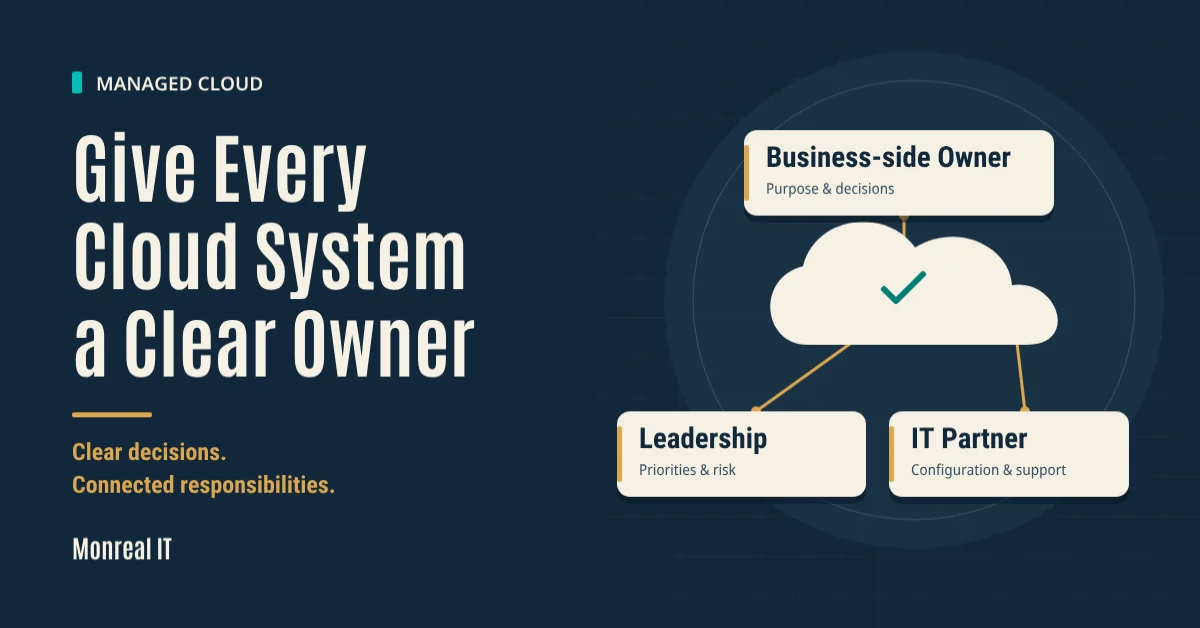
Bill Monreal : October 1, 2026Clarify who owns your cloud systems, approves changes, and reviews performance so business decisions don't fall between your team and IT.
6 min read
Bill Monreal : September 24, 2026Give internal AI better source material. Start with approved documents, clear owners, current information, and access that matches people's work.