6 min read
Make Company Knowledge Reliable Before AI Uses It
 Bill Monreal : September 24, 2026
Give internal AI better source material. Start with approved documents, clear owners, current information, and access that matches people's work.

Your accounting platform needs a change. Finance expects IT to approve it. IT needs someone to confirm the business requirements. The request sits while everyone assumes someone else owns the decision.
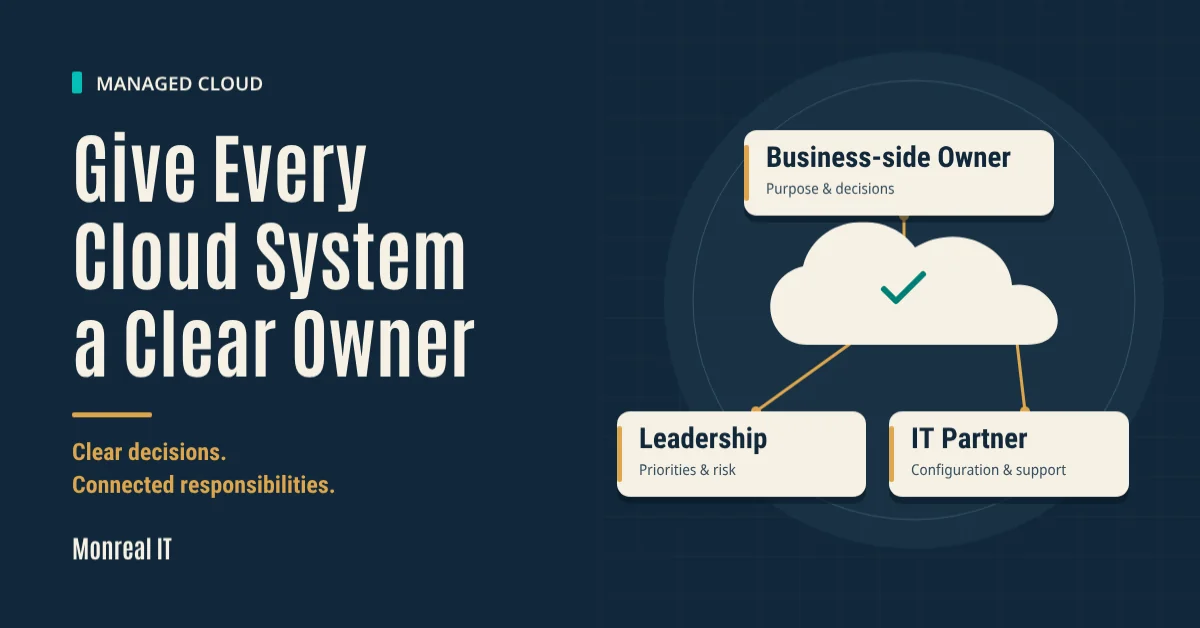
Give each important cloud system a named business-side owner: the person accountable for how it supports the team's work. Pair them with a technical owner and clear decision authority. Document who approves access, changes, spending, and recovery priorities. Then review those assignments as the business changes. The goal isn't another layer of bureaucracy. It's helping people make the right decisions without chasing an answer across departments.
At Monreal IT, we see cloud as an operating model. Where a system runs matters, but so does how you manage it after it's live. Cloud, cybersecurity, managed IT, data analytics, and AI depend on decisions that connect across the business.
The business-side owner is the person accountable for how the system supports a business process or department. They should understand that work and have authority to make or escalate decisions about it. That might be your controller for an accounting application or your operations manager for a production scheduling system. This role doesn't require an ownership stake in the company.
They don't need to configure the technology. They need to define what useful performance looks like, approve business requirements, and confirm who should have access. Naming them doesn't automatically mean granting administrator permissions.
The technical owner handles the agreed technical responsibilities. Depending on your arrangements, that could be an internal IT team, a managed services partner, or a combination of both. Leadership resolves decisions that exceed the business-side owner's authority, such as material spending or changes to accepted risk.
Microsoft's cloud operating model guidance calls for documented responsibilities across governance, security, and operations, including partner roles. You can apply that principle without building a large enterprise department: name the people, define their authority, and make the handoffs clear.
“Finance owns it” isn't specific enough. Who approves a new user? Who decides whether a workflow change is acceptable? Who reviews the renewal? Who can authorize an exception, and when does it need leadership's attention?
Start with those decisions. Then write down who approves, who performs the work, and who confirms it's complete. One person may fill several roles in a smaller organization, but the responsibilities should still be distinct.
This is also where cybersecurity decisions belong. The business-side owner explains the legitimate need for access. Your IT and cybersecurity teams determine how to provide it within the agreed controls. A request that's convenient for one department still needs to fit the organization's risk requirements.
Cloud doesn't remove those obligations. Microsoft's shared responsibility guidance explains that customers retain responsibilities for their data, identities, and the components they control, with the technical division varying by service model. Confirm the details for each service and your actual agreements rather than assuming the provider handles everything.
Consider a hypothetical accounting firm that uses a cloud application for client work. Its controller owns the business requirements, its IT partner manages agreed technical tasks, and leadership approves spending beyond an established limit.
A request to connect another application should have a clear route. The controller confirms the business purpose and required data. IT reviews access, integration, support, and security implications. Leadership decides any unresolved budget or risk issue before implementation. The controller then checks whether the change supports the intended workflow.
That sequence helps keep one department's improvement from becoming another department's surprise. It's especially useful when you're fixing software sprawl, because a new subscription can introduce responsibilities that outlast the original request.
Agree on a backup contact, too. Documented responsibilities shouldn't disappear when someone takes vacation or changes roles. For systems supporting management reporting, this also helps make critical reporting less dependent on one person.
Use a short ownership record for each important system. Capture its business purpose, business-side owner, technical owner, backup contacts, approval limits, and review date. Add where people should request changes and how urgent issues get escalated.
Record the responsibilities that matter for that system: access reviews, renewals, data handling, integrations, recovery planning, and retirement. You don't need identical records for every application. A production-critical system deserves more detail than a low-risk tool used occasionally.
Keep the record accessible to the people who need it without including passwords or sensitive configuration details. Link it to your support and change process. A document nobody uses won't resolve a stalled decision.
If you're evaluating managed IT services Cleveland businesses use, ask how cloud responsibilities are divided between your team and the provider. A useful managed services relationship makes that division understandable and connects it to your business priorities.
Your cloud migration plan should include who will manage the system afterward. Go-live is a handoff into ongoing operations, and the ownership record should reflect it.
Revisit that record when a department reorganizes, a key person leaves, an integration changes, or a system takes on more important work. Use regular business reviews to check whether the purpose, responsibilities, and escalation route still fit. Choose a review frequency based on the system's importance and risk.
Microsoft's cloud operations guidance recommends naming owners and documenting procedures for changes, routine work, and business continuity. Those are separate tasks that need coordination. Closing a ticket alone doesn't tell you whether a recurring issue has been addressed or an ownership gap has been fixed.
Cloud ownership also matters before you connect AI to an existing workflow. The people accountable for the process should help settle its purpose, data readiness, governance, and human oversight before deployment. Adding automation doesn't transfer business judgment to the system.
Choose one important cloud system and walk through a recent request. Could everyone identify who approved it, who performed the work, and who confirmed the result? If not, use that request to define the missing handoff.
Don't make the business-side owner responsible for technical decisions they aren't equipped to make. Give them expert guidance and a clear escalation route. Equally, don't expect IT to decide which business tradeoffs leadership will accept.
At Monreal IT, our proven process, The Monreal Way, connects discovery, design, implementation, support, and ongoing management. Quarterly business reviews provide a place to revisit priorities and responsibilities as part of that continuing partnership.
Without clear ownership, the same decisions can keep circulating between teams. With it, people have a practical route to approval, execution, and review. Start Here with a Compatibility Check to explore whether Monreal IT is the right partner to help you bring that clarity to your technology operations.
6 min read
Bill Monreal : September 24, 2026Give internal AI better source material. Start with approved documents, clear owners, current information, and access that matches people's work.

6 min read
Bill Monreal : September 10, 2026Klarna, Ford, and IBM show why AI creates more value when automation handles repetitive work and people retain judgment.

7 min read
Bill Monreal : August 20, 2026Before buying more AI licenses, choose one KPI that proves whether the work saves time, lowers risk, or improves decisions.