6 min read
Give Every Cloud System a Clear Owner
 Bill Monreal : October 1, 2026
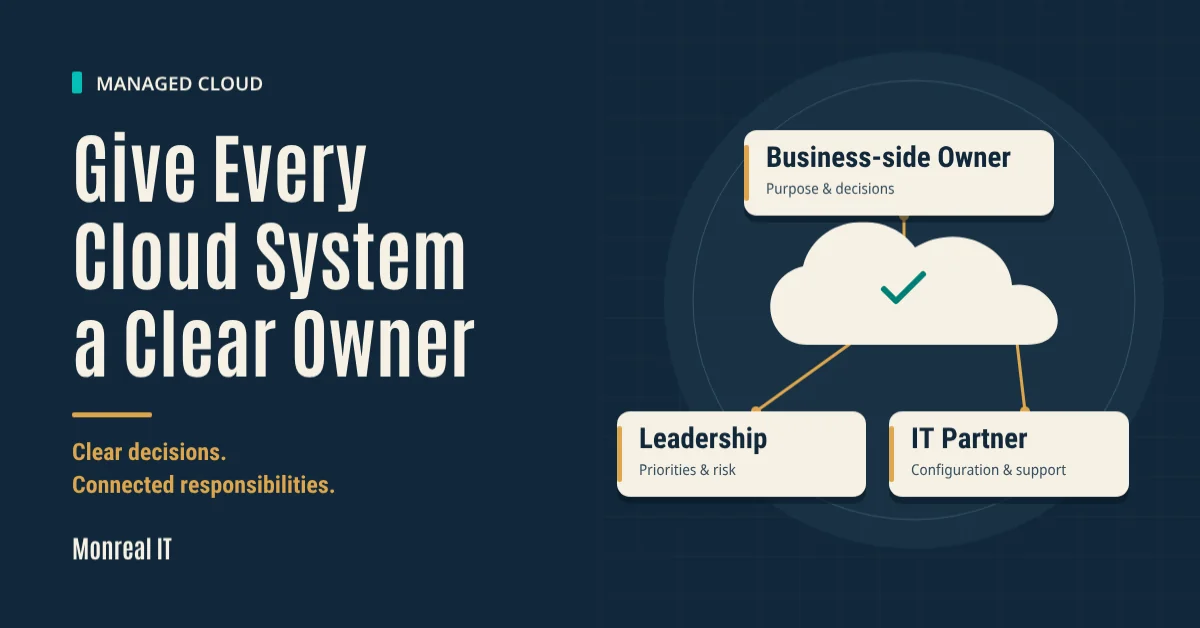
Clarify who owns your cloud systems, approves changes, and reviews performance so business decisions don't fall between your team and IT.

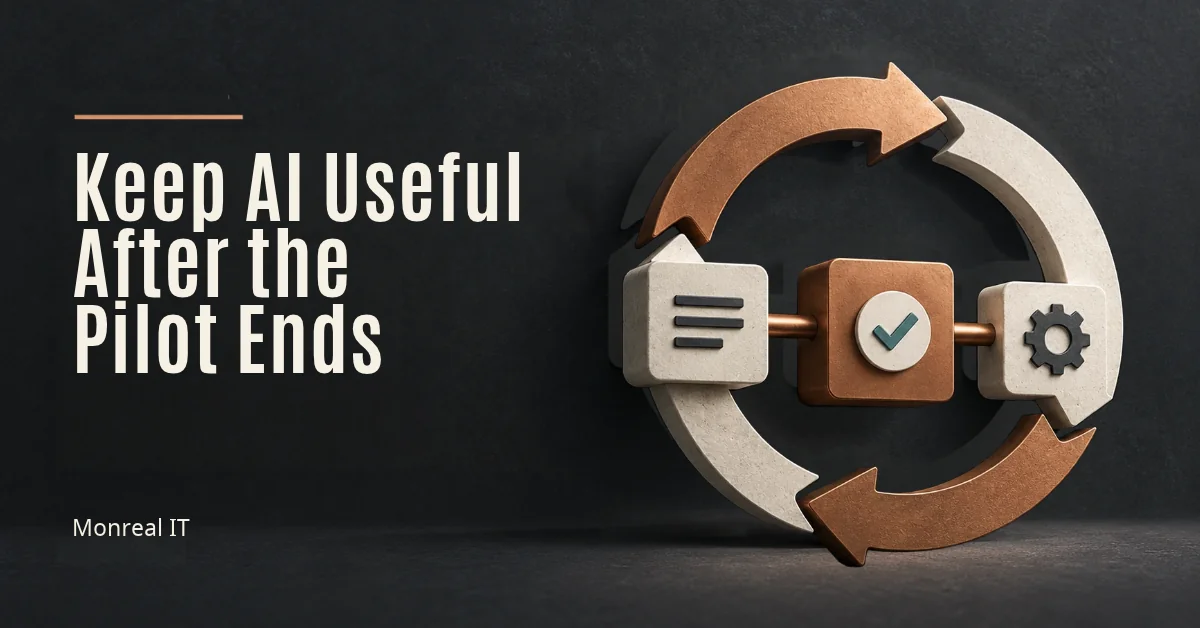
Your AI pilot worked. Employees used it, the agreed measure improved, and leadership approved the next step. Now the solution is part of everyday work. Who checks that it's still helping when the work changes?
Keep the business purpose, one primary KPI, and the approved boundaries visible after launch. Assign responsibility for reviewing results, testing changes, checking security, and responding to employee feedback. Agree on when to improve the solution, pause it, or retire it. A successful pilot supports a deployment decision. Ongoing management helps you decide whether that decision still makes sense.
At Monreal IT, we treat AI as a capability you build, govern, measure, and improve. Launch is one step in that work. It doesn't replace the need to manage what comes next.
Start with the whole workflow. A language model may draft an answer, while an integration retrieves information and an automation routes it for approval. Each part needs attention. The business result depends on how they work together, including the people responsible for judgment.
For an accounting firm, that might mean checking an invoice-processing workflow from document intake through employee approval. For a manufacturer, it might mean reviewing how an internal assistant supports staff using approved procedures. These are illustrative scenarios, not claims about a particular client or outcome.
NIST's AI Risk Management Framework calls for ongoing monitoring, user feedback, and change management after deployment. It's voluntary guidance, not a certification or proof of compliance. Its practical lesson is useful: plan how you'll manage the solution throughout its life, rather than treating launch approval as permanent approval.
Use the single KPI agreed in advance during the pilot as your starting point. Keep its definition consistent enough to compare results. Record the baseline, the measurement method, and who reviews it.
Suppose your primary KPI is staff time spent preparing a customer response. Include the agreed review work in that measure. A faster first draft doesn't necessarily mean a faster completed response if employees spend more time correcting it. Compare similar work, and explain changes in workload or case complexity.
One primary KPI doesn't mean one thing matters. Quality, security, and appropriate human review remain conditions for use. Check running costs and management effort when reviewing ROI, too. Don't let a favorable time measure excuse an unacceptable answer or data-handling problem.
If the business purpose changes, revisit the KPI deliberately. Document why it changed instead of quietly moving the target to make performance look better.
The documents, integrations, instructions, and models supporting a solution can change. So can the questions employees ask. A pilot scorecard won't tell you whether every later change is acceptable.
Keep a small, approved set of representative test cases, including awkward or incomplete inputs. Use it to compare behavior before and after material changes. Include examples from actual work only when their use is permitted and the data is handled appropriately.
Microsoft's guidance on AI monitoring and evaluation distinguishes pre-production testing from monitoring after deployment, including scheduled tests and checks of sampled production activity. The exact tools depend on your implementation. The management principle is broader: gather evidence about how the solution performs in the environment where people actually use it.
Record what changed, who approved it, and how you'll restore the previous arrangement or use a manual process if needed. Expanding to another department should trigger a review of its purpose, data, permissions, and oversight before use.
Useful output and appropriate access belong in the same conversation. A solution shouldn't gain access to additional information just because a new connection is convenient.
Review the data it can reach, the people and service accounts using it, and the permissions its integrations require. Confirm that departures and role changes are reflected in access. Decide what diagnostic records you need, who can see them, and how long they're retained. Collecting every input and output without a purpose can create another place where sensitive information needs protection.
Keeping company knowledge reliable matters here, too. Confirm that approved sources are current and remain appropriate for the intended users. A new document or changed permission can affect both usefulness and risk.
Connect these reviews to your cybersecurity program and your managed services responsibilities. AI, cloud, data, and IT operations need to support the same business boundaries.
Human judgment needs a defined place in the workflow. “Someone will check it” isn't a sufficient operating plan.
Name who reviews outputs, which decisions need approval, and what employees should do when an answer is uncertain or inappropriate. Give people a practical route to report problems, with enough context to investigate without unnecessarily sharing protected information.
Return to the hypothetical customer-response workflow. A staff member checks the draft against the approved source before sending it. If the source is missing or conflicting, they use the established manual route and flag the issue. The aim is useful assistance with a clear boundary, not automatic sending simply because the text sounds confident.
Review the feedback with the people doing the work. Their experience can reveal repeated corrections, missing steps, or a solution that's technically available but rarely useful.
Match the review frequency to the workflow's importance, pace of change, and consequences of error. A solution handling sensitive information deserves different attention from a low-risk internal drafting aid. Review after significant changes as well as on the agreed schedule.
Keep the review practical: the business result, recent changes, employee feedback, costs, security issues, and actions with named owners. You don't need a large dashboard to make a useful decision.
Agree on pause conditions in advance. Those might include unexpected access to restricted data, repeated unacceptable outputs, or loss of a required approval step. Define who can suspend use and how work continues safely while the issue is investigated. Retirement is a valid outcome when the business need disappears or the solution no longer earns its place.
Without this attention, leadership can keep funding a solution on the strength of an old pilot. With it, you have a clearer basis for continuing, improving, or stopping the work.
When you search for “managed IT services Cleveland,” ask prospective partners who manages deployed AI and what that responsibility includes. Clarify the scope, review cadence, change approvals, escalation path, and ownership of documentation.
Monreal IT's Managed AI approach starts with an AI Game Plan Assessment, prioritizes use cases, settles governance before deployment, and pilots a limited solution against one KPI. We then manage and improve the solutions we implement after go-live, with security and portability as our two principles.
Your next step is to review one deployed workflow against its original purpose and identify any gaps in its management. If you'd like help planning that work, Start Here with Monreal IT's Compatibility Check.
6 min read
Bill Monreal : October 1, 2026Clarify who owns your cloud systems, approves changes, and reviews performance so business decisions don't fall between your team and IT.

6 min read
Bill Monreal : September 24, 2026Give internal AI better source material. Start with approved documents, clear owners, current information, and access that matches people's work.

6 min read
Bill Monreal : September 10, 2026Klarna, Ford, and IBM show why AI creates more value when automation handles repetitive work and people retain judgment.