6 min read
Turn IT Records Into Action for Fewer Disruptions
 Bill Monreal : November 19, 2026
Learn how connected IT records, automation, and human oversight can help resolve issues faster, reduce repeat problems, and catch trouble earlier.

6 min read
Bill Monreal :
November 26, 2026
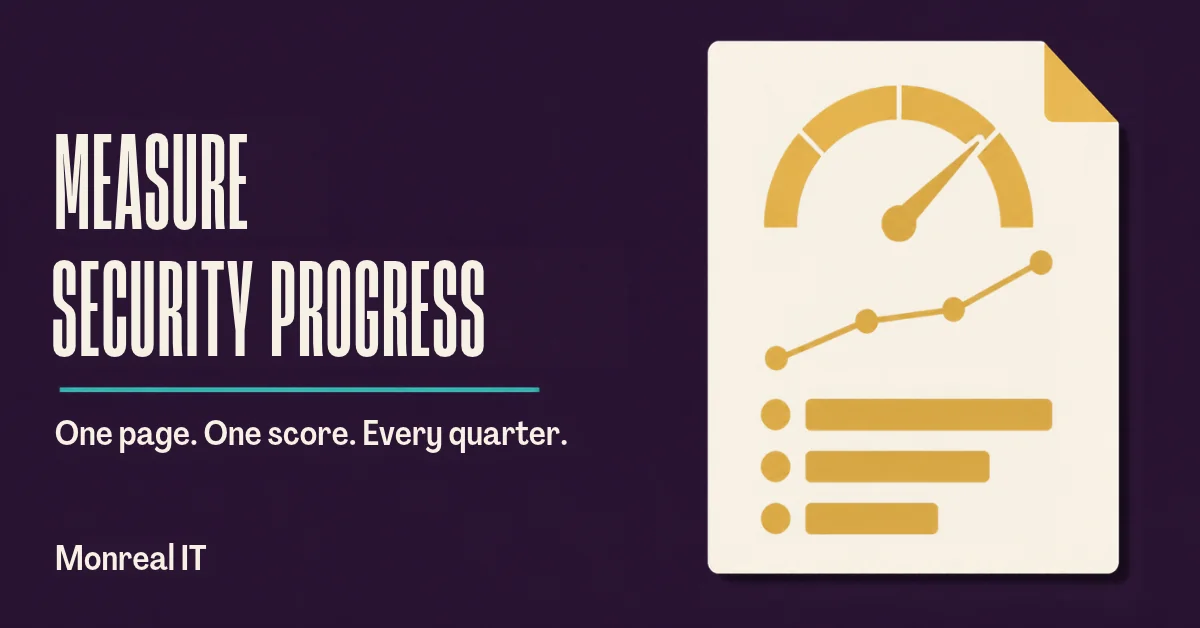
Most offices go quiet over Thanksgiving. Before yours does, here's a question worth putting to your leadership team: is the company more secure than it was last Thanksgiving, and could you show it?
Most owners and CFOs can't answer that, and it's not for lack of reports. They get lists of activity: patches applied, tickets closed, tools renewed. What they don't get is a position.
A security scorecard gives you one. It's a single page that measures your environment against a recognized standard, turns the result into a score, and tracks that score every quarter. Next to the number sit the biggest open gaps, ranked by business risk, each with an owner and a date. That's enough for a leader to see whether security is improving, what's holding it back, and which decisions are waiting on them.
Because most security reporting describes effort, not outcomes. A 40-page vulnerability export is accurate, and it's no help in a budget meeting. A list of products says what you bought, not what you're protected against.
That's a business problem showing up through technology. We believe cybersecurity is a business issue that starts with risk, not products. Leaders decide how much risk the company carries, what gets funded, and what waits. They can't make those calls from a tool inventory. They need a measure they can read without a translator, and one that holds still long enough to compare this quarter with the last one.
A scorecard is only as credible as what it's scored against. If the yardstick is one provider's opinion or one product's dashboard, the number mostly tells you how much of that product you've turned on.
A published standard fixes that. Our managed cybersecurity practice is built on NIST SP 800-171, the National Institute of Standards and Technology's set of security requirements for protecting controlled unclassified information outside federal systems. It covers the ground that matters in most businesses: who has access, how devices are configured, how activity is logged, how incidents are handled, and how people are trained.
The work behind the score is a gap analysis. Each requirement gets an honest answer: it's implemented and you can prove it, or it isn't. If you're an aerospace or defense supplier, this is the standard your contracts already point to. If you're an accounting firm or a manufacturer without defense work, you don't need a federal contract to borrow the discipline. The same page is useful when a customer asks for proof of your cybersecurity, or when you're gathering proof for a cyber insurance application.
One timing note: NIST published Revision 3 in May 2024, and the Department of Defense's assessments still use Revision 2 and its 110 requirements. Your scorecard should say which revision it's measured against.
The simplest score is the percentage of requirements you've met. The defense supply chain uses a weighted version, and its method is worth understanding even if you never bid on a defense contract.
Under the Department of Defense's scoring method, you start at 110, one point for each requirement. Every requirement that isn't fully implemented subtracts 1, 3, or 5 points, depending on how much it matters. Miss enough of the heavily weighted ones and the score goes negative. The published range runs from -203 to 110.
The weighting is the point. Two companies can each have twenty open gaps and land on very different scores, because one of them is missing multifactor authentication and the other is missing a handful of lower-weight items. A weighted score pulls attention toward the gaps that carry the most risk, which is where a leader's attention belongs.
For defense suppliers, this number isn't optional. CMMC's third-party certification milestones are paused, but self-assessment obligations still apply, and the score is posted to a Department of Defense system. That's one more reason to keep it honest.
Keep it to what a leader can act on:
That fourth line matters more than it looks. Not every gap gets closed, and sometimes that's a reasonable business decision. When a client declines one of our recommendations, we ask for a formal sign-off, so the accepted risk stays visible instead of fading into an old email thread.
A number invites gaming, so treat it with some discipline.
Self-scored numbers drift upward. "Implemented" should mean it's working, documented, and provable, not planned or mostly done. Ask what evidence sits behind any line marked complete.
A higher score isn't immunity. It measures how well requirements are implemented. It doesn't promise you won't have an incident. What it supports is resilience: a better-run environment is easier to defend and easier to recover.
Scores can drop for honest reasons. Open a new facility, acquire a company, or add a major system, and the scope grows. A scorecard that never goes down probably isn't being updated.
And don't chase easy points. Closing ten 1-point items feels productive while a 5-point gap sits open.
Measuring once is an audit. Measuring every quarter is ongoing management. With our clients, we track a security scorecard toward 100% and review it in quarterly business reviews, because The Monreal Way, our proven process, works in quarterly increments: pick the gaps with the most business impact, close them, and measure again. The open items feed the technology budget, so security spending follows risk rather than the latest product pitch.
It also connects to everything else you want from technology. Security isn't a silo. The same access controls, device standards, and logging that raise your score are what make cloud systems and AI safe to rely on. As we like to say, there is no AI without security, and there is no security without AI.
Any managed IT services company Cleveland business owners trust with security should be able to put a page like this in front of them every quarter. If yours can't, or if you're not sure where your number would land, Start Here with our Compatibility Check. We'll begin with the business outcomes you're after and whether we're the right fit to help.

6 min read
Bill Monreal : November 19, 2026Learn how connected IT records, automation, and human oversight can help resolve issues faster, reduce repeat problems, and catch trouble earlier.
6 min read
Bill Monreal : October 15, 2026Shared PCs need clear access, safe handoffs, and planned support. Learn what business leaders should include in their IT plan.

6 min read
Bill Monreal : September 3, 2026Crypto agility helps your business change encryption without chaos. Learn why an inventory and transition plan matter before standards shift.