6 min read
Crypto Agility Keeps Encryption Change From Becoming a Crisis
 Bill Monreal : September 3, 2026
Crypto agility helps your business change encryption without chaos. Learn why an inventory and transition plan matter before standards shift.

The CMMC pause is real. The relief some defense suppliers feel is understandable.
It is also easy to misunderstand.
On July 13, 2026, the Department of War announced that it was suspending the Cybersecurity Maturity Model Certification Phase II requirements that had been scheduled to take effect on November 10, 2026. That pause affects the next phase of CMMC implementation, especially the broader move toward third-party certification requirements.
It doesn't mean cybersecurity compliance stopped mattering. It doesn't erase existing contract language. It doesn't make NIST SP 800-171 optional for organizations handling controlled unclassified information. And it doesn't necessarily stop a prime contractor from asking you for evidence before it shares sensitive information or keeps you in the supply chain.
The practical takeaway is simple: don't confuse a rollout pause with a business pause. If cybersecurity obligations are already in your contracts, in a solicitation, or in a prime flow-down, you still need a clear picture of what applies and where your evidence stands.
The pause concerns CMMC Phase II implementation. In plain English, the Department put the scheduled transition to the next phase on hold while it reviews the program and looks for a more scalable approach.
That matters. Many small and mid-sized suppliers were preparing for the cost, scheduling pressure, and evidence demands of third-party assessments. A pause can create breathing room, especially for organizations that were racing the calendar more than they were improving security.
But breathing room is not the same as permission to stop. The Department's own CMMC guidance says Phase I self-assessment requirements remain in place. It also says cybersecurity compliance with NIST 800-171 Rev. 2 will continue through self-assessments and selected government-led assessments during the review period.
That's the part worth slowing down for. The headlines are about CMMC. The obligations many suppliers live with day to day are often in DFARS clauses, SPRS scoring, system security plans, plans of action, and prime contractor expectations.
DFARS 252.204-7012 still matters when it appears in a covered contract. That clause is the one tied to safeguarding covered defense information and reporting cyber incidents. It points contractors handling covered defense information toward the security requirements in NIST SP 800-171.
DFARS 252.204-7019 and DFARS 252.204-7020 still matter for NIST SP 800-171 DoW Assessment requirements. In practical terms, those provisions and clauses are connected to having a current assessment, posting summary-level scores in SPRS, and giving the government visibility into the assessment status of covered contractor information systems.
Prime flow-downs still matter, too. A prime contractor may have its own supply-chain risk requirements. It may ask for an SPRS score, a system security plan, a plan of action and milestones, a self-assessment, or other evidence before awarding work or sharing controlled information. The Department can pause a phase of its program. Your prime still controls its supplier risk decisions.
That's why this issue belongs in the same conversation as what cyber insurance may expect from your business and how to prove cybersecurity maturity to a major customer. Buyers, primes, insurers, and regulators are all moving toward the same basic question: can you show your work?
For many organizations, the danger is not that they have no cybersecurity work underway. The danger is that leadership does not know which systems are in scope, which controls are actually implemented, what evidence exists, and what the current score really means.
A self-assessment shouldn't be a quick spreadsheet someone updates once and forgets. It should be tied to real systems, real data flows, and real business decisions. If controlled unclassified information lives in Microsoft 365, an ERP system, file shares, engineering systems, email, or backup environments, the assessment has to reflect that reality.
The same is true for the system security plan. If the SSP says a control is implemented, someone should be able to explain how. If a control is not fully implemented, the plan of action should be honest about what remains, who owns it, and how risk is being managed in the meantime.
This is where standards-grounded work beats panic. NIST 800-171 is not a product list. It is a control framework. The point is not to buy a tool for every acronym. The point is to understand the environment, close the highest-risk gaps first, and build evidence that can survive a serious conversation.
Defense suppliers often focus on the federal deadline because it is visible. Prime contractors can be more immediate.
If a prime is under pressure to protect its own programs, it may set supplier requirements that are stricter or faster than the government's current rollout timeline. That can include requests for questionnaires, attestations, score summaries, documentation, or proof that certain controls are in place before a supplier can receive data or continue supporting a program.
That is not just a compliance issue. It is a revenue protection issue. A supplier that can't answer basic cybersecurity questions may look risky even if the formal CMMC timeline has shifted.
This is also where executive sponsorship matters. If cybersecurity is treated as an IT side project, the business may miss the contract risk until the request is already on the table. Owners, CFOs, COOs, operations leaders, and IT need the same view of the obligation: what contracts say, what primes require, where protected information lives, and what evidence exists today.
For organizations comparing managed IT services partners in Cleveland, this is one of the questions worth asking directly: can the provider connect day-to-day IT operations, cybersecurity controls, cloud configuration, documentation, and compliance evidence into one managed system?
Start with the contract language. Don't rely on headlines, summaries, or assumptions. Look for DFARS 252.204-7012, 252.204-7019, 252.204-7020, and any CMMC-related language in solicitations, contracts, task orders, and prime flow-downs. If the language is unclear, involve qualified contracting or legal counsel.
Next, confirm where controlled unclassified information is created, received, stored, processed, or transmitted. Scope drives everything else. If the scope is wrong, the score is probably wrong, the evidence is probably incomplete, and the remediation plan may aim at the wrong target.
Then review the current NIST 800-171 assessment. Make sure the score in SPRS, the SSP, and the plan of action tell the same story. If the score is old, unsupported, or based on assumptions, treat that as a business risk. A confident "we're fine" without evidence is not confidence. It is exposure with nicer packaging.
After that, prioritize the gaps that carry the most operational and contract risk. Identity controls, multifactor authentication, endpoint protection, logging, incident response, backup resilience, access reviews, and data handling practices often deserve early attention because they affect both security and evidence.
Finally, create a rhythm for review. CMMC may change again after the Department's review, but the underlying need will not disappear. Cybersecurity requirements, customer expectations, and proof demands are moving toward more accountability, not less.
The CMMC pause may change timing. It should not change the direction.
If your organization handles controlled defense information or receives cybersecurity requirements from a prime, the better move is to use the breathing room well. Validate your scope. Clean up the self-assessment. Make the SPRS score defensible. Strengthen the controls that matter most. Keep documentation current. Ask your primes what they still expect.
That's not fear-based compliance; it's responsible business management.
Most businesses don't have a technology problem. They have a business problem showing up through technology. In this case, the business problem is clarity: which obligations still apply, which evidence is ready, and which gaps could affect the next contract conversation.
Monreal IT helps regulated and compliance-driven organizations regain control through cybersecurity and applied AI, enabling secure and confident operations. If CMMC confusion has your team stuck between waiting and overreacting, start with a clear assessment of your contracts, scope, security posture, and evidence. The goal is not to chase every headline. The goal is to be ready for the obligations that still apply.

6 min read
Bill Monreal : September 3, 2026Crypto agility helps your business change encryption without chaos. Learn why an inventory and transition plan matter before standards shift.

7 min read
Bill Monreal : August 13, 2026Cyber insurance asking for proof? Start with MFA, backups, endpoint protection, response planning, and clear security documentation.
9 min read
 Monreal IT : July 2, 2026
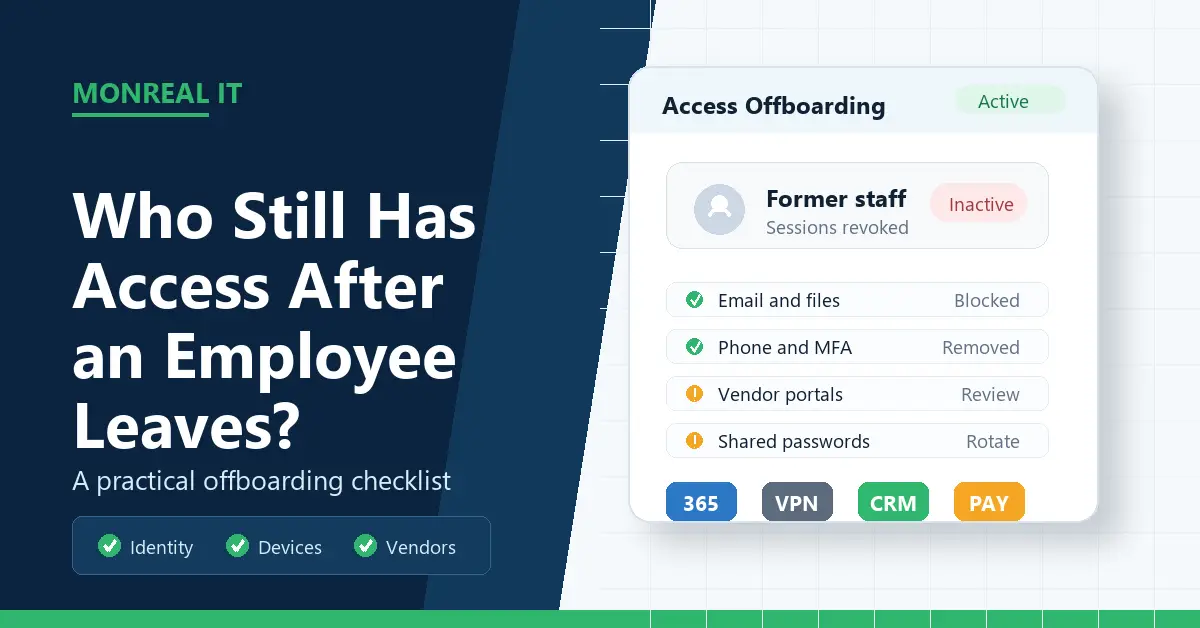
When an employee leaves, access can linger in apps, email, files, and vendors. Use this practical offboarding checklist to close the gaps.