6 min read
Crypto Agility Keeps Encryption Change From Becoming a Crisis
 Bill Monreal : September 3, 2026
Crypto agility helps your business change encryption without chaos. Learn why an inventory and transition plan matter before standards shift.

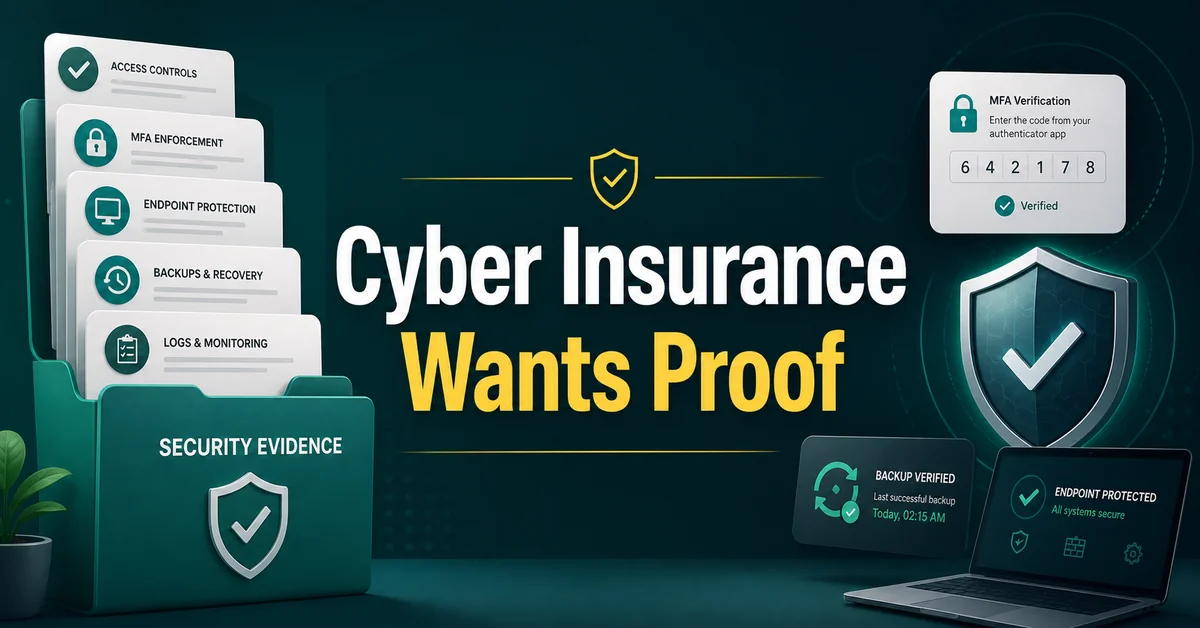
If your cyber insurance renewal suddenly feels more like an audit than an application, you're not imagining it. Insurers have become more specific about what they want to see before they quote, renew, or keep certain coverage terms in place.
That can feel annoying, especially when you're already running a business, practice, shop floor, or professional services team. But the request itself is not the enemy. In many cases, the insurer is asking for proof of the same security basics that would help your business survive a real incident.
The right move is not to panic-buy tools or answer "yes" because you mostly think something is covered. The right move is to slow down, gather evidence, and build a short improvement plan where the proof is weak.
Every carrier has its own questionnaire, appetite, and underwriting process, so there is no universal cyber insurance checklist. Still, several questions show up often enough that they deserve early attention.
Start with multi-factor authentication. You should know where MFA is required, where it is optional, and where it is missing. Pay close attention to email, Microsoft 365, remote access, administrator accounts, financial systems, and any application that stores sensitive client or patient information. CISA's small business guidance treats MFA as a practical way to reduce account compromise risk, and insurers tend to care about it for the same reason.
Next, review endpoint protection and monitoring. A questionnaire may ask whether you use antivirus, endpoint detection and response, managed detection, or a security operations center. The wording matters. Basic antivirus and active endpoint detection are not always viewed the same way by an underwriter.
Then look at backups. Do you back up critical files and systems? Are backups separated from the main network? Are they protected from deletion? Most importantly, has anyone tested recovery recently? A backup that has never been restored is a comforting theory, which is not quite the same as a recovery plan.
Finally, gather your incident response plan. It does not need to be a novel. In fact, for a small business, a short and usable plan is usually better than a beautiful document nobody can find. It should explain who makes decisions, who contacts insurance, who contacts IT, who preserves evidence, and what systems matter first.
Here is where many businesses get stuck. They may have decent security controls, but the evidence lives in scattered screenshots, old emails, vendor portals, invoices, and someone's memory. That makes renewal stressful because the business has to recreate its security story every year.
A better approach is to build a simple evidence folder. Include MFA policy screenshots, endpoint protection summaries, backup job reports, recovery test notes, user access review records, security awareness training completion, vulnerability or patching summaries, and the current incident response plan.
This is not busywork. It helps leadership understand whether cybersecurity is actually being managed. It also makes conversations with brokers, carriers, auditors, and vendors calmer because you're not starting from a blank page.
This is one reason cybersecurity should not sit off to the side as an occasional project. It should connect to your everyday IT operations. The same team helping with onboarding, offboarding, Microsoft 365, device management, and help desk patterns should also understand how those decisions affect risk and insurance readiness. If you're comparing a managed IT services company Cleveland businesses can rely on, ask how they document security controls throughout the year, not just when a renewal deadline appears.
Insurance questionnaires can be uncomfortable because a simple yes-or-no answer may hide important nuance. For example, "Do you require MFA?" could mean all users, only administrators, remote access, email, privileged systems, or every cloud application. "Do you back up data?" could mean files, servers, SaaS platforms, cloud workloads, or line-of-business applications.
Guessing creates risk. If a claim happens later, inaccurate answers can become a very expensive problem. That does not mean you need to be afraid of every question. It means you should answer carefully, document assumptions, and ask your broker or carrier for clarification when the wording is unclear.
Our professional opinion: a careful "not yet, here is the remediation plan" is usually healthier than a confident answer nobody can prove. It gives leadership a real path forward and avoids building the business's risk plan on optimism and vibes. Vibes are not a control family.
If the questionnaire is due soon, focus your first week on clarity.
First, identify the systems the insurer cares about most: email, remote access, administrative accounts, financial systems, file storage, backups, endpoints, and sensitive data repositories.
Second, confirm the current state. Pull screenshots, reports, policies, and vendor documentation. If something cannot be verified, mark it as unknown instead of assuming it is fine.
Third, prioritize the largest gaps. MFA on email and administrative accounts usually belongs near the top. So do tested backups, endpoint protection, patching discipline, and offboarding controls. A medical practice, accounting firm, or manufacturer may also need to show stronger controls around regulated data, vendor access, or production systems.
Fourth, write the remediation plan in plain English. Name the gap, the business risk, the owner, the next action, and the target date. This turns the renewal process into a manageable project instead of a scramble.
Fifth, decide how the evidence will stay current. The best time to prepare for next year's cyber insurance renewal is not three days before the broker asks for documents. Quarterly reviews are boring in the best possible way. They keep surprises small.
NIST Cybersecurity Framework 2.0 is useful here because it gives leaders a business-friendly way to organize security work: Govern, Identify, Protect, Detect, Respond, and Recover. For a small business, that does not mean turning the office into a compliance factory. It means using a recognized structure to ask better questions.
Govern: Who owns cyber risk decisions?
Identify: What systems, data, vendors, and accounts matter most?
Protect: What safeguards reduce the chance of compromise?
Detect: How would we know something went wrong?
Respond: Who acts when there is an incident?
Recover: How do we restore operations and communicate clearly?
That structure also helps connect cyber insurance readiness to broader business resilience. The goal is not just a cleaner questionnaire. The goal is a business that can keep operating, protect trust, and make better technology decisions with fewer surprises.
When a business comes to Monreal IT with an insurer request, we usually start by separating proof from promises. What can we verify today? What needs cleanup? What needs a budgeted plan? What should be explained to the broker before the deadline?
From there, the work becomes much less mysterious. Managed IT keeps the environment organized. Cybersecurity strengthens the controls and documentation. Cloud and Microsoft 365 decisions get reviewed through a security lens. Data and AI conversations become safer because the foundation is better understood.
That connected approach matters because cyber insurance is not really asking, "Did you buy a tool?" It is asking, "Can you show that your business manages risk in a responsible, repeatable way?"
If the answer is not yet, that's fixable. Start with the evidence, close the highest-risk gaps, and build a simple rhythm for keeping proof current. The questionnaire may still be picky, but at least it will be picky in a room with receipts.

6 min read
Bill Monreal : September 3, 2026Crypto agility helps your business change encryption without chaos. Learn why an inventory and transition plan matter before standards shift.
7 min read
Bill Monreal : August 27, 2026CMMC Phase II is paused, but DFARS, NIST 800-171, SPRS scores, and prime flow-downs may still apply. Here's what defense suppliers should do.
9 min read
 Monreal IT : July 2, 2026
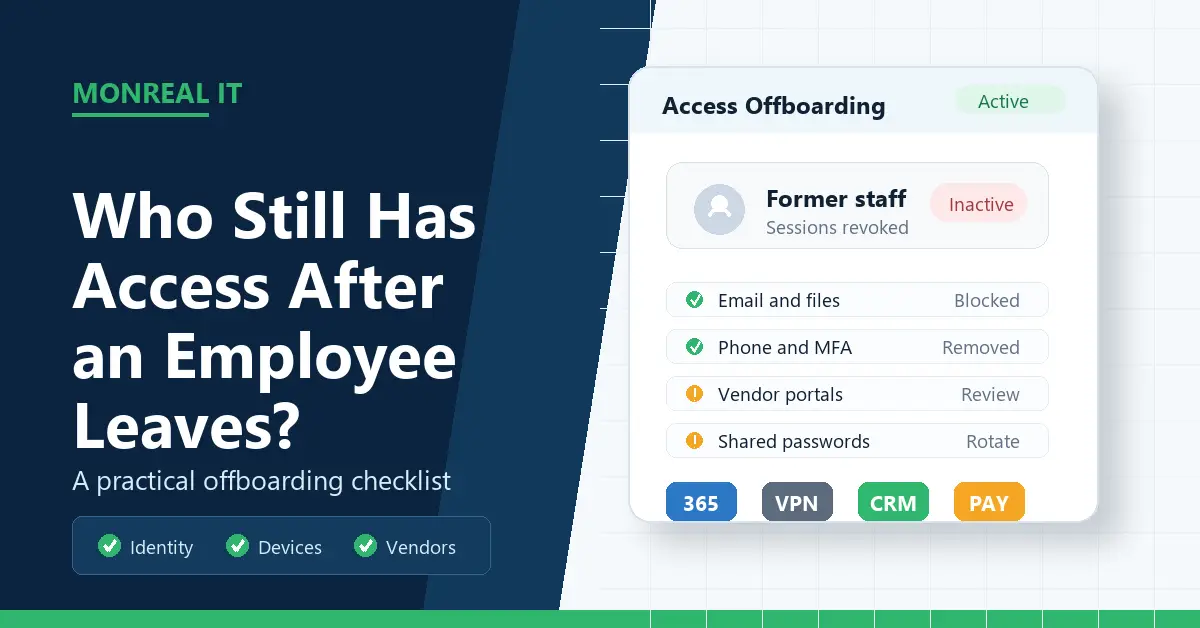
When an employee leaves, access can linger in apps, email, files, and vendors. Use this practical offboarding checklist to close the gaps.