6 min read
Keep AI Useful After the Pilot Ends
 Bill Monreal : October 8, 2026
Keep deployed AI focused on business results with ongoing performance reviews, security checks, human oversight, and a clear plan for changes.

An AI demo can produce a polished summary, a clever spreadsheet formula, or a convincing customer email in less time than it takes to refill your coffee. That makes it easy to approve a pilot. It does not make the pilot valuable.
The harder question comes a month later: did the experiment improve the business enough to justify more licenses, more training, and more access to company data? If nobody defined success before the pilot began, the answer usually comes down to enthusiasm. The loudest fan says it was transformative. The busiest employee says they never had time to use it. Finance sees another subscription. Everyone is technically correct, which is not especially helpful.
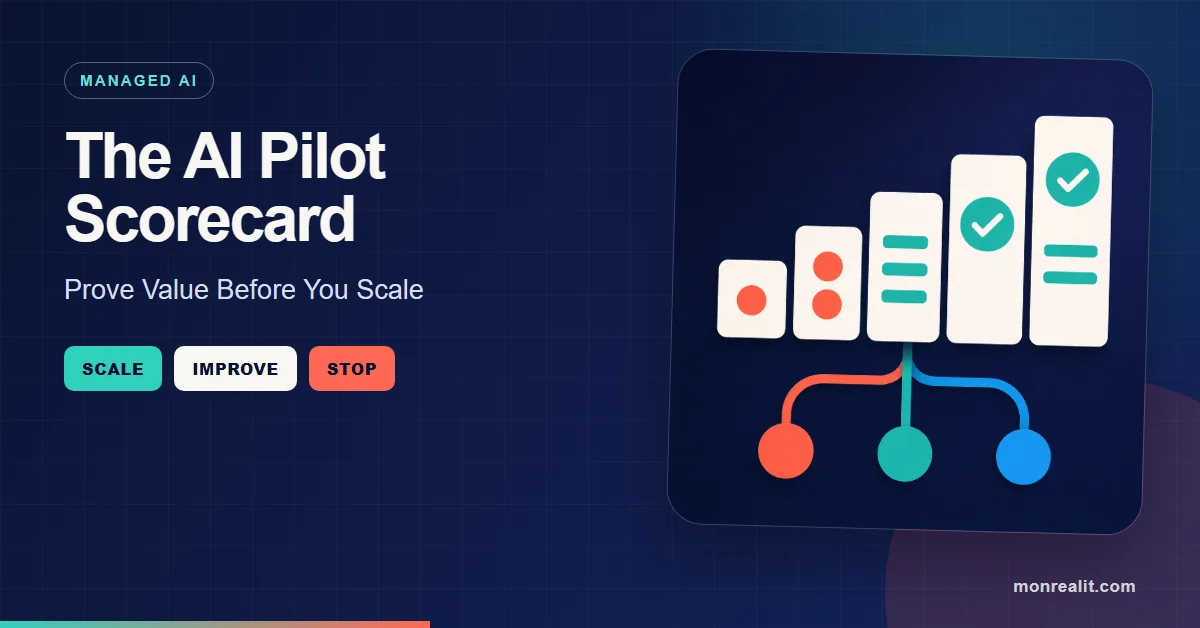
A simple AI pilot scorecard gives leadership a better way to decide. It connects the experiment to one business outcome, measures whether people can use it safely, and creates a clear choice: scale it, improve it, or stop it.
The strongest pilots begin with a workflow that is already slow, repetitive, inconsistent, or frustrating. The weakest begin with a license and a hopeful request to “go find some use cases.”
Before selecting the tool, describe the current process in plain language. Who does the work? How often? What part causes delay or rework? What would improve for the business if that friction disappeared?
For example, an accounting team might spend too much time turning meeting notes into follow-up emails and task lists. A manufacturer might struggle to summarize long quality reports for supervisors. A professional services firm might want to reduce the first-draft time for routine proposals without lowering accuracy or exposing client information.
This is the same discipline behind asking whether your organization is ready for AI before you invest. A pilot should test a specific improvement, not whether artificial intelligence is generally interesting. We already know it is interesting. So are office espresso machines, but they still need a business case.
Every pilot needs one primary key performance indicator tied to the bottleneck. Pick the measure that would make a leader care if it improved.
Useful examples include average minutes per completed task, turnaround time, rework rate, first-response time, cases processed per week, or the percentage of work completed by a deadline. Establish the baseline before introducing AI, then measure the same process during the pilot.
Suppose a six-person accounting team currently spends an average of nine minutes turning each client meeting into a reviewed follow-up email. The pilot goal could be to reduce that average to six minutes while keeping the correction rate below an agreed limit. Those are sample targets, not universal benchmarks. The right number depends on the workflow, the risk, and the cost of a mistake.
Our professional view is that one meaningful KPI beats a dashboard full of impressive-looking activity. Prompt counts and login rates can explain what happened, but they are not the business outcome. A team can send hundreds of prompts and save no useful time at all.
The primary KPI tells you whether the workflow improved. Four guardrail measures tell you whether the improvement is usable, safe, and worth scaling.
First, measure adoption and workflow fit. Track how many pilot participants use the tool for the approved task, how consistently they use it, and where they abandon the process. Microsoft’s Copilot adoption guidance recommends measuring a mix of outcomes, adoption, quality, and readiness to scale. Usage matters because a technically capable tool still fails when it adds steps, interrupts the workflow, or requires prompt acrobatics only one enthusiast understands.
Second, measure output quality. Define what “good enough” means for the task and have a qualified person review a useful sample. Depending on the workflow, you might track factual corrections, missing fields, rejected drafts, or time spent fixing the output. Do not grade AI by how confident it sounds. Confidence is one of its cheaper features.
Third, measure risk and control performance. Record whether users entered prohibited data, skipped required review, received harmful or materially incorrect output, or needed to escalate a concern. The NIST AI Risk Management Framework describes measurement as a mix of quantitative and qualitative methods connected to the deployment context. That is a useful reminder that a pilot can save time and still fail if its controls do not hold up.
Fourth, calculate the real cost. Include licenses, setup, integration, training, employee time, quality review, security work, and ongoing support. A $30 license is not a $30 solution when three people spend two weeks making it usable. On the other hand, a pilot with meaningful setup costs may still be worthwhile if the workflow repeats often enough and produces measurable value.
Keep the scorecard short enough to review in one meeting. A practical version can use five categories:
| Category | Question | Example Evidence |
|---|---|---|
| Business value | Did the primary KPI improve enough to matter? | Cycle time, throughput, rework, or response time |
| Adoption | Did the intended users apply it consistently? | Weekly use for the approved workflow and user feedback |
| Quality | Was the output accurate and usable after review? | Correction rate, rejected work, and review time |
| Risk | Did the controls protect data and catch bad output? | Incidents, policy exceptions, and escalations |
| Cost | Is the total cost reasonable for the measured gain? | Licenses, labor, training, integration, and support |
Score each category with a simple red, yellow, or green rating and attach the evidence. Green means the pilot met the agreed threshold. Yellow means the idea may be sound but needs a specific correction. Red means the result or risk does not justify moving forward.
Do not average the colors into false comfort. A green value score should not cancel a red risk score. If an AI workflow saves hours but exposes protected health information or sends unchecked advice to clients, the pilot is not “mostly successful.”
Set the decision rules before the results arrive. That keeps the team from quietly moving the goalposts because everyone has become attached to the tool.
Scale when the primary KPI improves, the controls work, users can repeat the workflow, and the economics remain sensible beyond the pilot group. Expansion should still happen in phases. The lessons from our other article, "Managed AI’s First 90 Days," are especially useful here because a successful test does not remove the need for training, governance, support, and review.
Improve when the business case is promising but one or two correctable issues remain. Maybe users need a better prompt template, the source data needs cleanup, or the approval step is too cumbersome. Give the revised pilot a deadline and a new test. “Keep experimenting” is not a decision unless it comes with an owner, a change, and a date.
Stop when the workflow does not improve, adoption remains low after reasonable support, quality is unreliable, risk is unacceptable, or total cost overwhelms the gain. Stopping is not failure. A contained pilot that prevents a bad company-wide purchase has done useful work.
The scorecard becomes more valuable when you reuse it. Over time, leadership learns which workflows respond well to AI, which teams need more enablement, and which controls should be standard. That turns scattered experiments into a managed capability.
It also keeps the technology connected to the rest of the business. An honest Microsoft Copilot review can help leaders understand the platform, but the purchase decision should still depend on their own workflow, users, data, and success measures. Good AI governance does not slow useful adoption. It gives the organization enough evidence to move faster without guessing.
If you found this article after searching for “managed IT services Cleveland,” the partner you choose should be willing to define the score before recommending more licenses. That means pairing evidence with practical AI adoption, clear cybersecurity fundamentals, and a well-run managed services strategy.
Start with one workflow. Write down the baseline. Pick one KPI and four guardrails. Then agree on what green, yellow, and red mean before the pilot begins. The goal is not to prove that AI works. It is to learn whether this use of AI works for your business.
6 min read
Bill Monreal : October 8, 2026Keep deployed AI focused on business results with ongoing performance reviews, security checks, human oversight, and a clear plan for changes.
6 min read
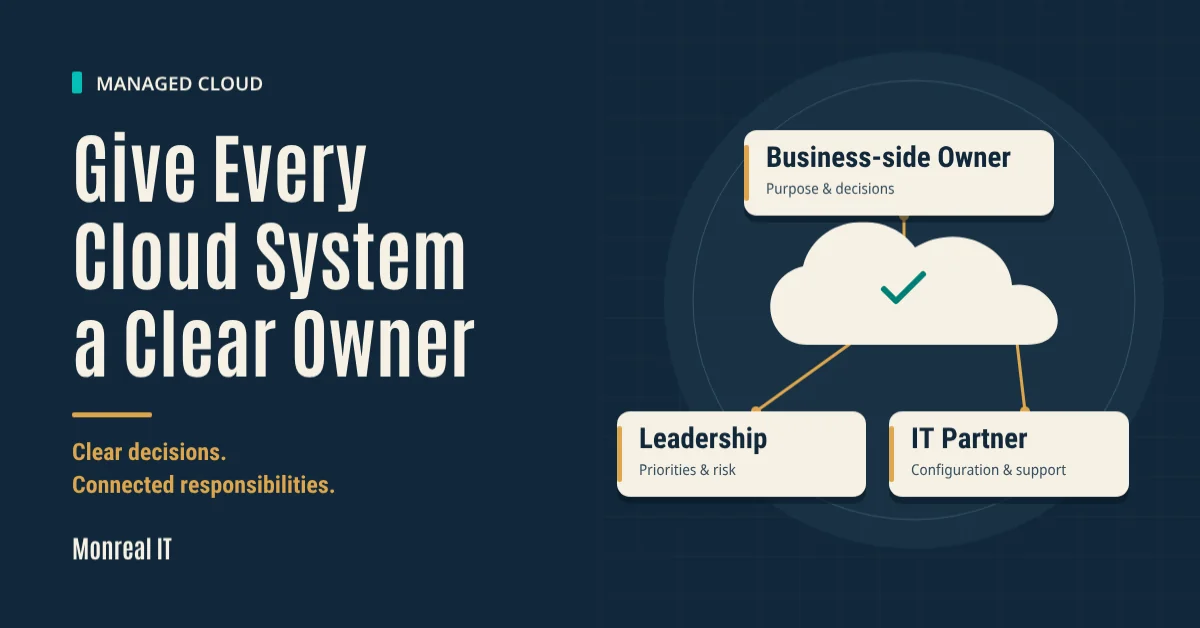
Bill Monreal : October 1, 2026Clarify who owns your cloud systems, approves changes, and reviews performance so business decisions don't fall between your team and IT.

6 min read
Bill Monreal : September 24, 2026Give internal AI better source material. Start with approved documents, clear owners, current information, and access that matches people's work.