6 min read
Give Employees a Practical Path to Using AI Well
 Bill Monreal : October 22, 2026
Help employees use AI confidently with approved workflows, clear data boundaries, hands-on practice, and human review tied to business outcomes.


AI can reduce repetitive work, shorten response times, and help a good team accomplish more. What it can't do is make every judgment call a business depends on. Klarna, Ford, and IBM each found that boundary in a different way. Their experiences don't make a case for retreating from AI. They make a case for using it with a clearer business purpose, better process design, and a human in the loop.
For owners, CFOs, and COOs, that's the practical answer to the headcount question. Don't begin with, “How many positions can we remove?” Begin with, “Which work is repetitive, measurable, and low risk enough to automate?” Then decide where human context, accountability, and customer trust still matter. AI is a capability, not a tool, and certainly not a shortcut around operating discipline.
In February 2024, Klarna reported that its AI assistant was handling two-thirds of customer service chats and doing work equivalent to 700 full-time agents. The company also said customers could still choose a live agent. A little more than a year later, CEO Sebastian Siemiatkowski said an emphasis on cost had contributed to lower service quality, and the company began recruiting people so customers would continue to have a human option.
The important lesson isn't that automated service has no value. It can handle common requests quickly and consistently. But customer service also contains frustration, ambiguity, exceptions, and moments when trust is more important than speed. If the only KPI is cost per interaction, a business can improve the number while weakening the relationship.
That distinction matters well beyond financial services. An accounting client with a sensitive question or a manufacturer facing a production interruption doesn't experience support as a queue of interchangeable tickets. The customer experiences the whole business through that moment. Automation should clear routine work so people have more capacity for the conversations that require judgment.
Ford's lesson came from quality engineering. In June 2026, Bloomberg reported that the automaker had hired, promoted, or brought back 350 veteran engineers over three years. Some were former employees and others came from suppliers. Their job wasn't to abandon automation. It was to mentor younger engineers and improve AI tools that weren't delivering the needed results.
That nuance matters. Automated quality systems can process enormous volumes of data, spot repeatable patterns, and run checks with impressive consistency. They can't infer decades of undocumented experience that never made it into the training data or workflow. When critical knowledge walks out the door, the technology doesn't magically recreate it.
For a small or mid-sized manufacturer, the safer sequence is to document the process, identify its exceptions, and involve the experienced people who already know where the process breaks. Then the organization can decide which business process to automate first based on productivity yield, risk, and measurable value. The veteran operator or engineer isn't an obstacle to automation. That person is often the key to making it work.
IBM presents a more balanced example. Its AskHR platform handled more than 11.5 million interactions in 2024, with 94% contained within the platform. IBM's CEO later said AI had eliminated a couple hundred HR positions while the company's total employment remained constant and hiring increased in programming and sales. IBM's own account also says specialized HR partners continued to handle the questions that couldn't be resolved inside AskHR.
In other words, routine work moved to automation, escalation remained human, and investment shifted toward different capabilities. IBM has also acknowledged that its original big-bang rollout was difficult and now advises organizations to start with a small pain point, make the solution work, and then scale.
That's a much more useful model than a simple replacement story. Good automation changes job design. It removes repetitive transactions and creates room for work that calls for analysis, creativity, relationship-building, and accountability. The human role doesn't disappear. It moves toward the work where human judgment matters most.
The three examples are different, but the operating pattern is consistent. A business identifies work that looks automatable, measures the technology's speed or cost, and then makes a workforce decision before it fully understands quality, exceptions, adoption, and ongoing management.
The better approach starts with the business outcome. Define the problem in plain language. Establish one KPI, agreed in advance. Map the process, including the ugly exceptions people usually carry in their heads. Set governance before deployment. Decide who owns the output, who reviews edge cases, and what triggers an escalation. Then run a limited proof-of-value pilot before changing the structure of the team.
This is also why AI can't be separated from the rest of the technology environment. The data must be usable. Access must be controlled. The automation must fit the real workflow. The managed cybersecurity foundation must protect the information moving through it, and the managed services model must support and improve the system after launch. There is no AI without security, and there is no security without AI.
If you're evaluating managed IT services Cleveland companies can use to support AI adoption, ask how the provider will govern, measure, secure, and manage the capability after it goes live. A license and a launch date aren't a management plan.
“Human in the loop” can sound like a cautious disclaimer. It shouldn't. It describes how practical AI creates value. Machines handle the mundane and repetitive. People handle judgment, creativity, collaboration, and accountability. The handoff between them is designed, measured, and improved.
That starts by choosing a narrow use case with the highest productivity yield and the lowest risk. It continues with how to pick one KPI before buying more AI licenses, a one-page AI policy, and a clear escalation path. It lasts because models, data, processes, and risks change after go-live. Ongoing management isn't optional maintenance. It's part of the capability.
The lesson from Klarna, Ford, and IBM isn't to wait. Businesses should get in on AI before competitors build an advantage. But they should move with discipline: governance first, proof-of-value before scale, and human judgment attached to the decisions that matter.
Monreal IT's AI Game Plan Assessment helps regulated and compliance-driven organizations identify practical use cases, test the strongest candidate against a single KPI, and build on two principles: security and portability. Start Here with a Compatibility Check at monrealit.com/compatibility-check, or call (440) 373-5805 to discuss a practical path forward.
6 min read
Bill Monreal : October 22, 2026Help employees use AI confidently with approved workflows, clear data boundaries, hands-on practice, and human review tied to business outcomes.
6 min read
Bill Monreal : October 8, 2026Keep deployed AI focused on business results with ongoing performance reviews, security checks, human oversight, and a clear plan for changes.
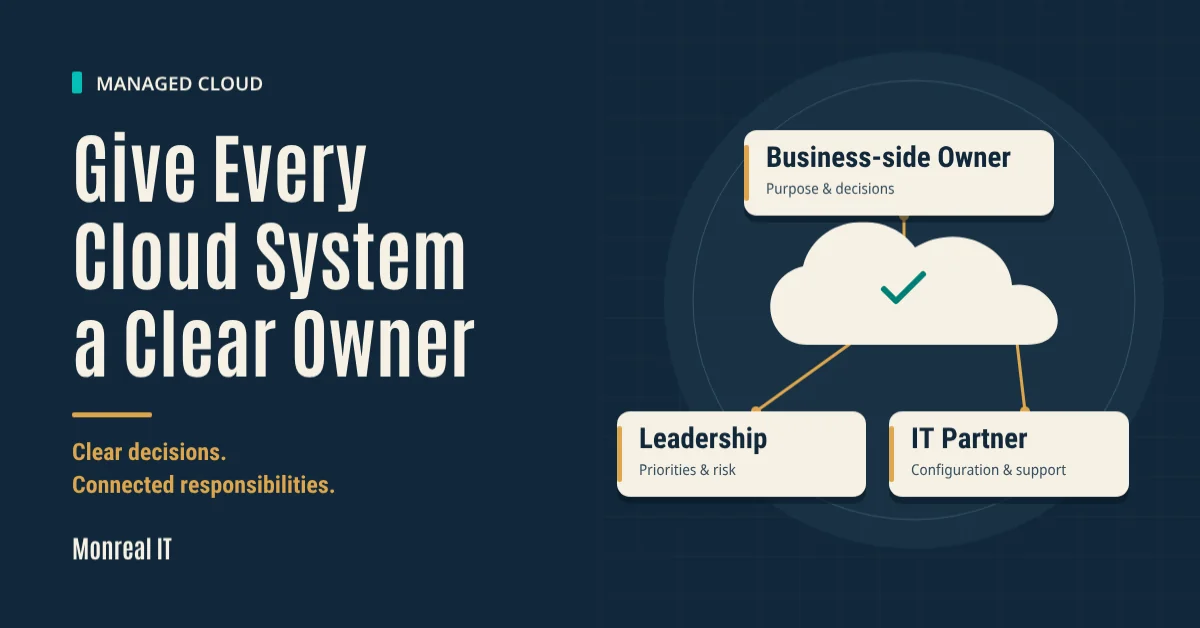
6 min read
Bill Monreal : October 1, 2026Clarify who owns your cloud systems, approves changes, and reviews performance so business decisions don't fall between your team and IT.