6 min read
The Rehire Report: AI Still Needs Human Judgment
 Bill Monreal : September 10, 2026
Klarna, Ford, and IBM show why AI creates more value when automation handles repetitive work and people retain judgment.

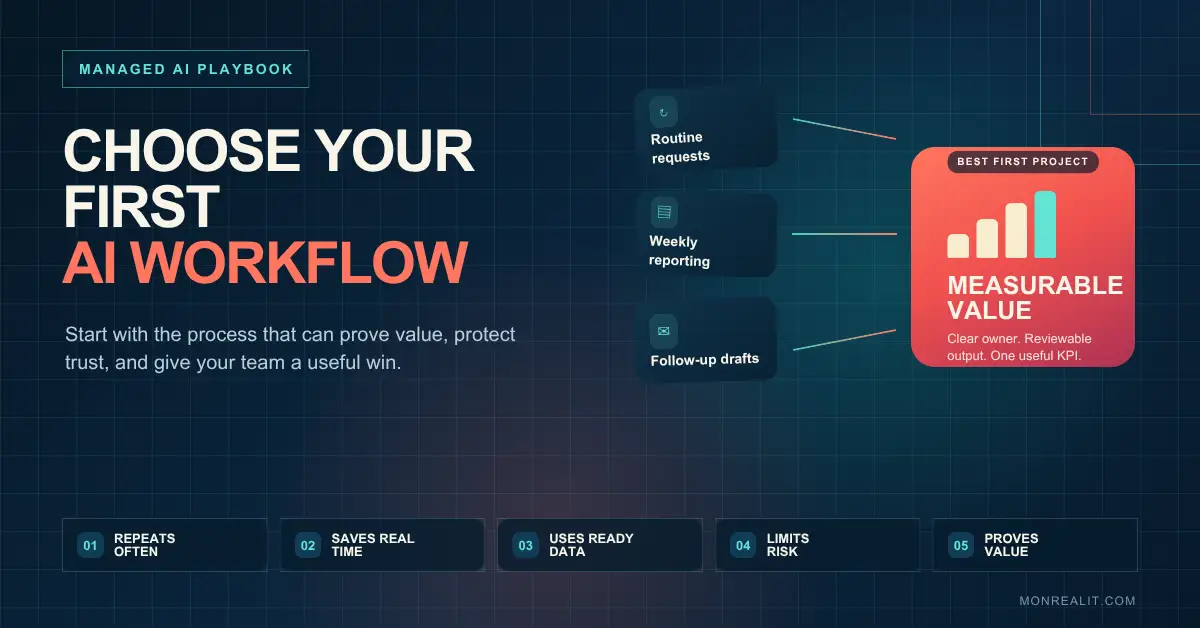
Buying an AI tool is easy. Choosing the first business process it should improve is where many teams get stuck.
One department wants an AI assistant for customer emails. Another wants automated reports. Someone saw a demo that could summarize every meeting since the invention of meetings. All three ideas may be useful, but starting all three at once makes it hard to tell whether AI created value or simply created more tabs.
Your first AI workflow doesn't need to transform the company. It needs to solve one visible problem, operate inside sensible boundaries, and produce a result you can measure. In our view, a modest workflow with a clear owner usually teaches a business more than an ambitious project with vague expectations.
Before comparing AI products, identify work that repeatedly slows people down. Ask employees where they copy information between systems, rewrite similar content, search for the same answers, or wait for routine reviews.
The strongest candidates are usually boring in a very useful way. Think about turning service notes into a consistent customer update, creating a first draft of a weekly operations summary, classifying incoming requests, or extracting standard fields from routine documents. These tasks consume time, follow a recognizable pattern, and still allow a person to check the output.
This is also where a dependable managed services foundation matters. AI inherits the condition of the environment around it. Messy permissions, disconnected applications, and unreliable data can turn a promising automation into a faster way to spread confusion.
If you aren't sure whether the foundation is ready, begin with how to tell whether your business is ready for AI. Readiness is less about owning the newest tool and more about having a defined problem, usable information, responsible access, and someone accountable for the outcome.
You don't need a complicated innovation committee to compare ideas. Score each candidate from one to five across these five questions.
A task performed 200 times a month offers more learning and potential value than one performed twice a year. Frequent work gives you enough examples to test the automation, spot patterns, and improve it.
Repetition alone isn't enough, though. A daily process that changes dramatically each time may be harder to automate than a weekly process with consistent inputs and steps.
Estimate the current time per task, monthly volume, and percentage AI could realistically assist. Keep the math honest. Saving four minutes on 500 monthly requests may matter. Saving four minutes on six requests probably doesn't.
Measure time that can be redirected toward higher-value work, not theoretical seconds shaved from a screen. For an accounting firm, that might mean less time organizing client documents and more time reviewing exceptions. For a manufacturer, it could mean faster preparation of a shift summary, while supervisors still investigate safety or quality concerns.
AI can't reliably summarize a report that employees can't find, and it can't classify requests consistently when the source data uses five names for the same issue. Check where the information lives, who can access it, how complete it is, and whether sensitive data is involved.
This step often exposes software sprawl or permissions that need attention before automation begins. That's useful information, not a failed AI project. Fixing the foundation can improve today's process even before AI enters the picture.
Every automation needs an error budget. A rough internal meeting summary can tolerate a correction. An incorrect payment instruction, patient recommendation, legal conclusion, or safety decision can cause real harm.
Start where mistakes are easy to spot, inexpensive to correct, and reviewed before action is taken. Cybersecurity should be built into every AI decision, but security isn't the only concern. Privacy, compliance, customer trust, and operational impact belong in the same conversation.
The NIST AI Risk Management Framework Playbook encourages organizations to understand the intended use and context of an AI system, measure relevant risks, and manage them over time. For a first project, that means documenting what the workflow is allowed to do, what it must never do, and where a person remains responsible.
Pick one primary outcome before building anything. It might be average handling time, hours returned per week, response consistency, backlog reduction, or the percentage of drafts accepted with minor edits.
Microsoft's guidance on AI-enabled business processes also emphasizes measurable, repeatable value instead of adding AI to isolated tasks without improving the full workflow. A clear baseline lets you compare the new process with the old one. Without it, a successful demo can quietly become an expensive habit.
Once you've scored the candidates, sort them by practical risk.
Green candidates are repetitive, text-heavy, easy to review, and connected to a measurable outcome. Examples include drafting routine follow-up messages from approved notes, summarizing internal documents, categorizing help desk requests, or preparing a first draft of a weekly KPI narrative.
Yellow candidates may be valuable but need tighter controls. Examples include customer-facing responses, analysis involving confidential information, recommendations that affect pricing, or workflows that update another system. These can become good projects after permissions, approval steps, and exception handling are defined.
Red candidates shouldn't be your first experiment. Avoid autonomous financial transfers, employment decisions, clinical conclusions, legal advice, safety actions, or any process where nobody can explain the inputs and verify the result. AI may eventually assist parts of these workflows, but the first pilot is the wrong place to discover the consequences.
Write the current workflow on one page: trigger, inputs, decisions, handoffs, output, owner, and common exceptions. Then mark the exact step where AI may help.
This prevents a classic mistake: automating a fast step inside a slow, broken process. Generating a proposal in 30 seconds doesn't help if pricing approval still takes four days. A better project may automate the intake and routing that causes the delay, or simply clarify who owns the approval.
If your search history includes “managed IT services & support Cleveland,” look for a partner who asks about the business process before recommending an AI license. The goal isn't to squeeze AI into every task. It's to connect the right capability to a result the organization cares about.
Choose a narrow group, a defined test period, and one accountable process owner. Record the baseline, train the users, review outputs, and give employees a simple way to report bad results or unexpected behavior.
A pilot should answer four questions: Did people use it? Did it improve the chosen metric? Were the outputs good enough with the planned level of review? Did it introduce new security, privacy, or process problems?
An AI pilot scorecard can keep that decision grounded when the demo glow wears off. It also creates a fair stopping rule. If the workflow doesn't produce enough value, pause it, adjust it, or choose a better candidate. Continuing simply because the team already invested time is how experiments turn into software clutter.
For a broader rollout, it also helps to know what managed AI's first 90 days can look like. A responsible program combines process discovery, data and security checks, a controlled implementation, employee support, and regular review. It isn't a one-time installation.
The right first AI process is usually visible, repetitive, measurable, and forgiving enough to support human review. It has clean enough inputs, a clear owner, and a business outcome more meaningful than “we used AI.”
Start with three candidate workflows. Score them against repetition, time returned, data readiness, error tolerance, and measurable value. Eliminate anything with unclear ownership or unacceptable consequences. Then pilot the strongest remaining option with real employees and a baseline you can defend.
That approach may feel less exciting than announcing an AI transformation. It is also far more likely to give your team a useful win, protect trust, and show you where AI belongs next.

6 min read
Bill Monreal : September 10, 2026Klarna, Ford, and IBM show why AI creates more value when automation handles repetitive work and people retain judgment.

7 min read
Bill Monreal : August 20, 2026Before buying more AI licenses, choose one KPI that proves whether the work saves time, lowers risk, or improves decisions.
6 min read
Bill Monreal : September 17, 2026Keep critical reporting moving when its usual owner is away. Document the logic, assign a trained backup, and test the handoff before you need it.